
Inside Vegan Curator’s Food Review Model
A closer look at the framework behind a more coherent way to evaluate food
The companion article, Rethinking How We Evaluate Food: Why Current Systems Fall Short—and the Case for a More Integrated Food Rating Model, argued that the central problem in modern nutrition is not a lack of information, but a lack of coherence [1]. Existing systems generate plenty of signals, yet they often evaluate food through fragmented and incomplete lenses, treating nutrition, processing, and ingredient quality as separate or unevenly weighted concerns. The result is not simply confusion, but a distorted understanding of healthfulness.
Against that backdrop, consumer demand for clear, accessible nutritional guidance [2] makes the problem more urgent: people need tools that are not only simple to use, but consistent in what they measure. The challenge is especially relevant to modern diets, where packaged and prepared foods now occupy a routine place in daily eating. Plant-based products are part of that landscape, yet they are often judged through broad assumptions rather than a fuller assessment of what they actually provide.
The Vegan Curator Food Review Model is designed to address that gap by evaluating processed plant-based foods through a more integrated framework. These products vary widely: some offer little nutritional value, while others can genuinely support a healthy eating pattern. By distinguishing between them more clearly, our review model helps move food evaluation beyond category labels and toward more meaningful dietary guidance.
What follows is a closer look at how the model works, from its underlying logic to the way its ratings are interpreted and applied.
Rooted in Science
The Vegan Curator Model is not an attempt to reinvent nutrition science. It applies it more faithfully. Drawing from the nutritional priorities established in the 2020–2025 Dietary Guidelines for Americans (DGA), the model evaluates individual foods in a way that is more transparent, internally consistent, and freer from private interests [3,4].
The 2020–2025 DGA remains one of the clearest federal frameworks for evaluating how foods contribute to nutrient adequacy, chronic disease prevention, and overall dietary quality [3]. It emphasizes nutrient-dense eating patterns while limiting overconsumed dietary components [3–6]. This approach is carried directly into the Vegan Curator Model’s scoring structure [4].
The decision to stay with these guidelines is deliberate because the 2025-2030 version of the dietary guidelines is weaker in key respects. It sends mixed messages by promoting health while giving animal meat and dairy elevated treatment despite stronger evidence in favor of plant-forward dietary patterns, retaining a 10% cap on saturated fat while still endorsing foods that are major sources of it, and placing new emphasis on processed foods without providing a clear operational definition of the term [7,8].
Since its publication, the 2025-2030 DGA has drawn significant scientific criticism [9], and major health organizations have diverged from its direction in important ways, favoring more plant-centered dietary patterns over greater reliance on animal-based foods [10].
For these reasons, the earlier guidelines provide the stronger scientific foundation on which the model rests.
Understanding the Vegan Curator Model
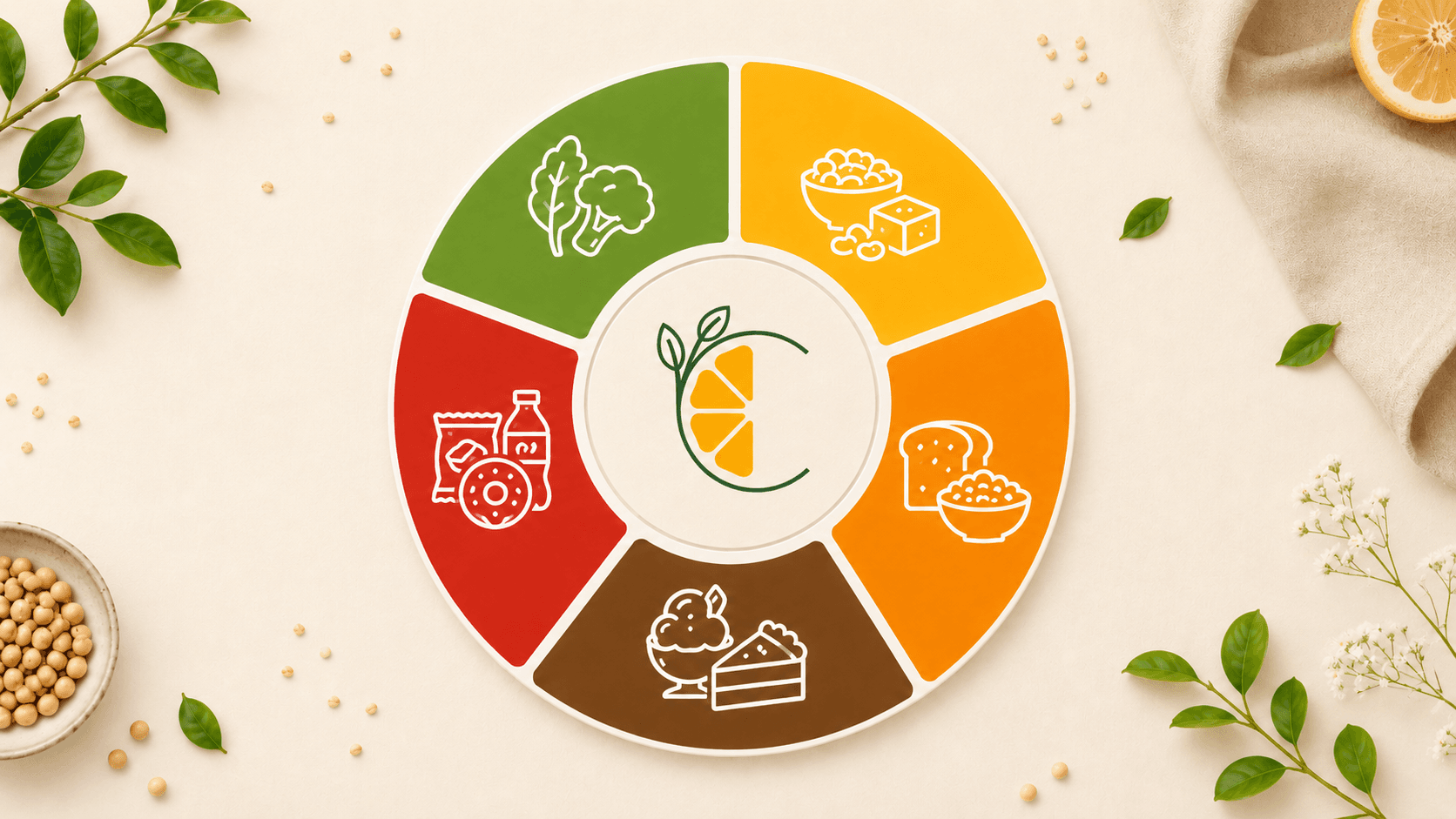
The Vegan Curator Model evaluates plant-based foods through a structured system designed to make food quality easier to interpret. Each product receives a score from –5 to +5, which is then translated into one of five usage tiers ranging from Staple to Rare. The purpose is not simply to rank foods, but to indicate how often a product can reasonably fit within a balanced plant-based dietary pattern.
The score is developed through two linked areas: nutrition and processing. Nutrition captures a product’s dietary strengths and limitations, while processing accounts for formulation and degree of refinement. Once calculated, the score is converted into a usage tier that gives the result practical meaning.
1. Nutrition
Nutrition scoring distinguishes between components that support dietary adequacy and those that can undermine it when consumed in excess. To make these priorities measurable at the level of individual foods, the model uses % Daily Value (%DV) as a reference point. %DV shows how much one serving provides toward the recommended daily amount for a given nutrient [11]. This makes it possible to assess whether a food meaningfully supports recommended intake—or supplies excessive amounts of nutrients that should be limited—within the serving size presented on the label. In that respect, %DV functions as a bridge between dietary guidance and product-level evaluation.
Nutrients to Limit
The first part of the score accounts for nutrients that can undermine dietary quality when consumed in excess. These include saturated fat, trans fat, sodium, added sugars, and sugar alcohols. Products are penalized when these components reach levels that compromise their nutritional profile.
For saturated fat, deductions begin above 10% Daily Value, while a small bonus may apply when saturated fat makes up no more than one-third of total fat. Any amount of trans fat triggers a deduction. Sodium is also penalized above 10% Daily Value, although a bonus may apply when potassium meets or exceeds sodium. Added sugars can reduce the score even at relatively low levels, with sharper penalties above 10% Daily Value, while sugar alcohols receive minor deductions.
The basis for these penalties is straightforward. Saturated fat remains closely linked to higher LDL cholesterol and cardiovascular risk [12,13]. Trans fat is penalized most strongly because it increases cardiovascular risk while offering no known health benefit [12,14]. Excess sodium contributes to hypertension and cardiovascular disease [15,16]. Added sugars raise energy intake without adding meaningful nutritional value [17,18]. Sugar alcohols count against the score because higher intakes can cause gastrointestinal discomfort and may raise broader health concerns [19].
Nutrients to Encourage
The second part of the model rewards nutrients that make a meaningful contribution to a healthier dietary pattern. These include dietary fiber, protein, and essential micronutrients.
Fiber is credited when a product provides at least 10% Daily Value or achieves a fiber-to-carbohydrate ratio of at least 1 gram of fiber per 10 grams of carbohydrate. Protein is rewarded when it reaches at least 10% Daily Value per serving. For micronutrients, only the single highest listed vitamin or mineral contribution is counted, preventing products from gaining an inflated score through long nutrient lists.
These attributes are rewarded because they reflect a food’s contribution beyond calories. Fiber supports satiety, digestive health, and long-term disease prevention [20,21]. Plant-based protein can help meet nutrient needs, and evidence linking protein source, meat intake, and chronic disease risk favors a more plant-forward approach to protein [22–25]. Micronutrients matter because essential vitamins and minerals play critical physiological roles, and inadequate intake can have serious health consequences [26,27].
How the Scoring Logic Works
Identifying the right nutrients is only part of the task. A usable model also has to decide when a nutrient becomes meaningful enough to reward, penalize, or interpret more closely. The Vegan Curator Model does this through two related tools: % Daily Value and nutrient ratios.
The %DV thresholds establish the model’s measure of nutritional significance. A 10% Daily Value serves as the first threshold: high enough to rule out trivial amounts, but low enough to capture meaningful intake or excess. A 20% Daily Value marks a more substantial level, helping distinguish stronger effects and preserve gradation in the score [11].
Nutrient ratios add a second layer of quality control by assessing balance, not just quantity. The saturated fat ratio recognizes that not all fat is the same, giving credit when saturated fat, which is linked to poorer health outcomes, makes up no more than one-third of the total fat in a product [12, 13, 28]. The fiber-to-carbohydrate bonus helps distinguish more intact, less refined carbohydrate sources from weaker ones, using a threshold of at least 1 gram of fiber per 10 grams of carbohydrate [29]. The sodium-to-potassium ratio applies the same logic to minerals: foods receive credit when potassium meets or exceeds sodium, reflecting evidence that higher potassium and lower sodium intake better support blood pressure and cardiovascular health [30].
These ratios also align with current FDA Daily Values [11]. Saturated fat is set at 20 g and total fat at 78 g, a more conservative benchmark than the model’s one-third cutoff but consistent with limiting saturated fat’s share of total fat. Fiber is set at 28 g and total carbohydrate at 275 g, meaning fiber represents about one-tenth of total carbohydrate. For sodium and potassium, the Daily Values are 2,300 mg and 4,700 mg, respectively, reinforcing the model’s preference for foods that are lower in sodium and richer in potassium.
Together, these thresholds and ratios help the model do more than count nutrients. They help it judge when a food makes a meaningful positive contribution, when it undermines dietary quality, and when its internal composition points to stronger nutritional integrity.
2. Processing
Beyond nutrients, the Vegan Curator Model evaluates how a product is made. Ingredient quality and degree of processing are treated as essential parts of food quality, not secondary considerations. Foods made from recognizable, minimally refined ingredients are favored, while products that rely heavily on industrial additives or highly manipulated formulations receive lower scores.
This part of the model is assessed through three checks: processing category, smart ingredient counting, and a blacklist scan.
Processing Category
Products are first evaluated according to defined processing categories. This structure also gives weight to ingredient order. Under FDA labeling rules, ingredients are listed in descending order of predominance by weight, which means the first ingredients generally make up the largest share of the product and therefore offer the clearest signal of its overall character [31].
With that principle in place, the model distinguishes among four processing categories.
Whole foods are single, recognizable foods such as whole grains, legumes, nuts, seeds, fruits, or vegetables that contain no added sugar, sweeteners, fats, oils, salt, flavors, or processing aids. Minimally processed foods contain five ingredients or fewer after smart lumping, use only permitted whole-food and minimally processed components, and include no sugar, sweeteners, added fats or oils, butter, margarine, or salt. Moderately processed foods contain eight ingredients or fewer after smart lumping, begin with a whole food or whole-food flour, and may include added sugars, fats or oils, salt, and plant-based protein isolates or concentrates, provided none of these appear first. Anything that does not fit these categories is treated as highly processed.
Smart Ingredient Counting
Because ingredient count is one of the signals used to classify processing level, it must be handled contextually rather than mechanically. Multiple forms of the same whole food are therefore counted as a single ingredient—for example, whole oats, rolled oats, and steel-cut oats count as one. Similarly, plain grains, legumes, nuts, seeds, fruits, and vegetables each count as one ingredient group; the same principle applies to plain herbs and spices, vegetable oils, and plant-protein isolates or concentrates. This prevents nutritionally useful ingredient diversity from being treated as excessive formulation complexity.
Blacklist Scan
The model also screens for ingredients associated with more heavily industrial formulations. This blacklist is informed by the Nova classification system, which identifies ultra-processed foods in part by the presence of additives and cosmetic ingredients not typically used in home cooking, including emulsifiers, artificial sweeteners, flavors, colors, and related formulation aids [32]. Foods containing industrial emulsifiers, hydrogenated fats, artificial or non-nutritive sweeteners, chemical preservatives, or similar markers of ultra-processing may therefore be flagged or excluded from more favorable processing categories.
At the same time, the model distinguishes these industrial markers from functional ingredients used in recognizable food production, such as coagulants used to make tofu. Limited exceptions also apply in narrow cases, such as when a single mild gum or thickener appears later in the ingredient list of a moderately processed plant-based product and no other blacklist criteria are violated. In this way, the model avoids a blanket additive rule, considering amount, placement, function, and context rather than simply flagging additives as such.
Taken together, these checks are meant to identify foods that retain greater integrity from source to shelf while still contributing positively to nutrient density.
Translating Scores into Dietary Roles
Once all points are tallied, the final score is translated into one of five usage tiers. Foods scoring from +2.0 to +5.0 qualify as Staple, but only if they are also minimally processed. Foods scoring +0.5 to +1.5, or scoring at least +2.0 without meeting the minimally processed requirement, are classified as Frequent. Scores of –1.0 to 0 fall into Occasional, scores of –2.5 to –1.5 into Limited, and scores of –5.0 to –3.0 into Rare.
Rather than imposing a rigid “healthy” or “unhealthy” label, these tiers convert the score into real-world use. A product may combine nutritional strengths with processing-related limitations, or it may be minimally processed but offer limited nutritional value. Within a dietary pattern rooted in whole plant foods, the tier helps clarify the product’s appropriate role. Even lower-rated products may have a place when used infrequently, in smaller amounts, or alongside more nutrient-dense options.
In this way, the rating serves as orientation rather than restriction, offering health-grounded guidance while preserving flexibility in actual eating habits.
Communicating the Rating
Once the Vegan Curator Model produces a result, the next challenge is turning a detailed food evaluation into something readers can use. The report cards accomplish this as part of the model’s evidence-informed structure, drawing on research about how visual design can shape people’s understanding of nutrition information.
One benefit is at-a-glance clarity. Each tier is assigned a color, giving users an immediate signal before they examine the details. Evidence on color-coded labeling supports this approach: a 2026 study in Current Psychologyfound that color cues can affect consumer perception and food choice by making nutrition details easier to notice and process [33].
A second benefit is interpretation. The quick highlights explain what sits behind the color cue, summarizing the product’s main strengths, drawbacks, and tradeoffs without requiring readers to work through the full scoring logic. This aligns with newer work on front-of-package labeling: in 2026, UC Davis highlighted findings suggesting that labels that clearly show saturated fat, sodium, and added sugars may communicate these nutrients more effectively than the FDA’s proposed approach [34].
As a result, the Vegan Curator report cards are not simply an add-on to the model. They are part of how the model works in practice: turning a complex assessment into actionable guidance.
Plant-Based by Design
The Vegan Curator Model was developed specifically for vegan food products, with criteria tailored to the nutritional and processing realities of plant-based foods. That focus matters because these foods generally differ from animal-based foods in important respects. They are often lower in several components associated with adverse effects or reduced tolerance, while providing nutrients and bioactive compounds linked with positive outcomes, including dietary fiber, antioxidants, vitamins C and E, and polyphenols.
Processing also requires context: some vegan products rely on functional ingredients or traditional preparation methods that should not be treated the same way as additives used to create heavily industrial formulations.
Even so, the model is not limited to plant-based foods in principle. It could be extended to animal-based foods while preserving its basic structure, provided that additional criteria are added to capture health, production, and contaminant-related risks that are more relevant to animal-derived products.
First, the model would need to account for dietary components that may warrant penalization when higher intake is associated with adverse health outcomes or population-specific sensitivities, including cholesterol, heme iron, saturated fat, lactose in dairy products, casein, whey, and other animal-derived proteins [35,36].
Second, an expanded model could penalize production practices that introduce risks beyond the nutrient profile of the food itself. Antibiotic use in some forms of animal agriculture is relevant because of its connection to antimicrobial resistance, which can make infections harder to treat [37,38]. Hormonal growth promoters raise a separate safety concern: although permitted in certain U.S. food-producing animals, the European Union prohibits their use in farm animals after scientific review concluded that no acceptable daily intake could be established for several hormones used in meat production [39].
Third, the model could account for risks related to food-chain position. Because animals generally sit higher on the food chain than plants, some contaminants can accumulate through feed, environment, and the wider food web, creating exposure risks [40,41]. Any such criteria would need to distinguish among production systems that reduce or increase these risks.
In this sense, the Vegan Curator Model is plant-based by design, but structurally adaptable. A broader version would need to preserve the same health-focused logic while adding criteria appropriate to animal-based foods.
Limitations
Like any evaluative framework, the Vegan Curator Model has limits. Some come from the data available on food labels, while others reflect judgment calls built into its design.
One limitation is serving size. Because serving sizes are not standardized across products, a food can appear nutritionally better or worse depending on how the manufacturer defines the portion. This is especially true when serving sizes do not reflect realistic, health-oriented portions.
A second limitation is that nutrition benchmarks are not perfectly neutral. Recommended intakes, Daily Values, and related standards are shaped by scientific evidence, but also by institutional history, policy choices, and evolving assumptions about what a healthy diet should look like. Because the model starts from these reference points, it can inherit some of their constraints.
The model also depends on ingredient order as a practical signal. Ingredient lists do not disclose exact percentages beyond certain labeling requirements [31], so precise proportions cannot be inferred from rank order alone. Ingredient reporting is also not fully standardized—for example, manufacturers may differ in whether they list sub-ingredients in parentheses—which can introduce inconsistency in interpreting product composition.
Finally, the model is limited by what appears on the Nutrition Facts label. Important attributes such as polyphenol content and omega-3 content are not consistently disclosed, even when they may contribute to a food’s health value. As a result, the model cannot systematically credit these features unless they are stated elsewhere in a reliable and usable way.
These limitations do not weaken the purpose of the Vegan Curator Model. They define its boundaries and point to where future refinement may be needed.
What the Model Is For
The Vegan Curator Food Review Model is intended to function as more than a numerical score. It is a framework for making sense of foods in a landscape often dominated by simplification, marketing, and incomplete signals. By evaluating nutrients, degree of processing, and ingredient integrity together, it aims to provide a more coherent basis for understanding how plant-based food products fit into a balanced diet.
Its purpose is not to reduce food to a rigid verdict, but to offer clearer orientation. Some processed plant-based foods may be best suited as staples, others as occasional choices, and others as products to use sparingly. What matters is not the label alone, but the food’s overall contribution to dietary quality over time.
In practice, our model is both an evaluation tool and a communication tool. It helps translate complex nutritional and ingredient information into guidance that is easier to interpret, compare, and apply. The goal is not perfection, but a better way to judge food: one that is more transparent, more consistent, and more aligned with health.
References
[1] Djurica, Gana. Vegan Curator. "Rethinking How We Evaluate Food: Why Current Systems Fall Short—and the Case for a More Integrated Food Rating Model." [Date Accessed: May 31, 2026]. https://vegancurator.com/pages/rethinking-food-evaluation
[2]. Holmes, Harry.”Yuka drives reformulation but leaves brands in the dark," FoodNavigator-USA. February 9, 2026. [Date Accessed: May 1, 2026]. https://www.foodnavigator-usa.com/Article/2026/02/09/yuka-drives-reformulation-but-shuts-out-food-makers/
[3] U.S. Department of Agriculture; U.S. Department of Health and Human Services. Dietary Guidelines for Americans, 2020–2025. 9th Edition. December 2020. DietaryGuidelines.gov. [Date Accessed: April 23, 2026]. https://www.dietaryguidelines.gov/sites/default/files/2020-12/Dietary_Guidelines_for_Americans_2020-2025.pdf
[4] Djurica, Gana. Vegan Curator. "How We Turn a Nutrition Label into a Simple, Honest Score." [Date Accessed: April 23, 2026] https://vegancurator.com/pages/how-we-rate-vegan-food
[5] Dietary Guidelines for Americans. Cut Down on Added Sugars. Office of Disease Prevention and Health Promotion. [Date Accessed: April 23, 2026]. https://www.dietaryguidelines.gov/sites/default/files/2021-11/DGA_FactSheet_AddedSugars_2021-06_508c.pdf
[6] Dietary Guidelines for Americans. Cut Down on Saturated Fat. Office of Disease Prevention and Health Promotion. [Date Accessed: April 23, 2026]. https://www.dietaryguidelines.gov/sites/default/files/2021-11/DGA_FactSheet_SaturatedFats-07-09_508c_0.pdf
[7] Inklebarger, Timothy. "Federal Diet Guidelines Accused of Bowing to Big Meat." FoodNavigator-USA, January 9, 2026. [Date Accessed: May 1, 2026]. https://www.foodnavigator-usa.com/Article/2026/01/09/20252030-dietary-guidelines-face-backlash-over-red-meat/
[8] Djurica, Gana. "New Dietary Guidelines — No. Just No." Vegan Curator, January 19, 2026. [Date Accessed: April 23, 2026]. https://vegancurator.com/blog/new-dietary-guidelines-just-no
[9] Hill, A., Lurie, P., & Gostin, L. O. (2026). New dietary guidelines for Americans: a recipe for poorer health. Lancet (London, England), 407(10531), 831–834. https://doi.org/10.1016/S0140-6736(26)00300-4
[10] Lichtenstein, A. H., Khera, A., Anderson, C. A. M., Appel, L. J., DeSilva, D. M., Gardner, C., Hu, F. B., Jones, D. W., Petersen, K. S., & American Heart Association (2026). 2026 Dietary Guidance to Improve Cardiovascular Health: A Scientific Statement From the American Heart Association. Circulation, 10.1161/CIR.0000000000001435. Advance online publication. https://doi.org/10.1161/CIR.0000000000001435 and https://www.ahajournals.org/doi/pdf/10.1161/CIR.0000000000001435?download=true
[11] U.S. Food and Drug Administration. "The Lows and Highs of Percent Daily Value on the Label." FDA. March 5, 2024. [Date Accessed: April 24, 2026]. https://www.fda.gov/food/nutrition-facts-label/lows-and-highs-percent-daily-value-nutrition-facts-label & U.S. Food and Drug Administration. "Daily Value on the Nutrition and Supplement Facts Labels." FDA. March 5, 2024. [Date Accessed: April 24, 2026]. https://www.fda.gov/food/nutrition-facts-label/daily-value-nutrition-and-supplement-facts-labels
[12] Reynolds, A. N., Hodson, L., de Souza, R. J., Pham, H. T. D., Vlietstra, L., & Mann, J. Saturated Fat and Trans-Fat Intakes and Their Replacement with Other Macronutrients: A Systematic Review and Meta-Analysis of Prospective Observational Studies. World Health Organization, February 28, 2023. [Date Accessed: April 28, 2026]. https://www.who.int/publications/i/item/9789240061668
[13] U.S. Department of Agriculture; U.S. Department of Health and Human Services. “Cut Down on Saturated Fat.” Dietary Guidelines for Americans, Office of Disease Prevention and Health Promotion. [Date Accessed: April 28, 2026]. https://www.dietaryguidelines.gov/sites/default/files/2021-11/DGA_FactSheet_SaturatedFats-07-09_508c_0.pdf
[14] World Health Organization. "Trans fat." World Health Organization. January 24, 2024.[Date Accessed: April 24, 2026]. https://www.who.int/news-room/fact-sheets/detail/trans-fat/
[15] World Health Organization. "Sodium reduction." World Health Organization. February 7, 2025. [Date Accessed: April 24, 2026]. https://www.who.int/news-room/fact-sheets/detail/sodium-reduction
[16] Zwager, C. L., Esseghir, M. I., van Vliet, A. M. C., Daams, J. G., Vogt, L., & Olde Engberink, R. H. G. (2025). Estimated Dietary Na+/K+-Ratio and Cardiovascular Disease: A Systematic Review and Meta-Analysis. Kidney & blood pressure research, 50(1), 712–722. https://doi.org/10.1159/000548424 and https://karger.com/kbr/article-pdf/50/1/712/4435733/000548424.pdf
[17] U.S. Food and Drug Administration. "Added Sugars on the Nutrition Facts Label." FDA. [Date Accessed: April 24, 2026]. https://www.fda.gov/food/nutrition-facts-label/added-sugars-nutrition-facts-label
[18] Shi, Z., Zhu, W., Lei, Z., Yan, X., Zhang, X., Wei, S., & Wang, Q. (2024). Intake of Added Sugar from Different Sources and Risk of All-Cause Mortality and Cardiovascular Diseases: The Role of Body Mass Index. The Journal of nutrition, 154(11), 3457–3464. https://doi.org/10.1016/j.tjnut.2024.09.017 and https://jn.nutrition.org/article/S0022-3166%2824%2901034-4/fulltext
[19] Qadir, Amjad Mahmood, and Rebaz Anwar Omer. "Safety of Sugar Alcohols on Human Health: A Review." International Journal of Food Science & Technology 61, no. 1 (2026): vvag012. https://academic.oup.com/ijfst/article/61/1/vvag012/8440984 and https://doi.org/10.1093/ijfood/vvag012
[20] Ardisson Korat, A. V., E. Duscova, M. K. Shea, et al. "Dietary Carbohydrate Intake, Carbohydrate Quality, and Healthy Aging in Women." JAMA Network Open 8, no. 5 (2025): e2511056. https://jamanetwork.com/journals/jamanetworkopen/fullarticle/2834202
[21] Machalias, Alicia, Jessica J. A. Ferguson, Trish Guy, and Eleanor J. Beck. "Cereal Fibers and Satiety: A Systematic Review." Nutrition Reviews 84, no. 1 (2026): 47–68. https://pubmed.ncbi.nlm.nih.gov/40644449/
[22] Campbell, T. Colin, and Thomas M. Campbell II. The China Study: Revised and Expanded Edition. Dallas: BenBella Books, 2016. https://benbellabooks.com/shop/china-study-revised-expanded-edition/
[23] World Cancer Research Fund International. Policy Blueprint for Cancer Prevention. 2025. [Date Accessed: May 1, 2026]. https://www.wcrf.org/wp-content/uploads/2025/02/PPA-Blueprint-Matrix-WEB.pdf
[24] Zouiouich, S., Wahl, D., Liao, L. M., Graubard, B. I., Hong, H. G., Loftfield, E., & Sinha, R. (2025). Meat Consumption in Relation to Colorectal Cancer Incidence in Anatomical Subsites in the National Institutes of Health-AARP Diet and Health Study. Current developments in nutrition, 9(9), 107540. https://doi.org/10.1016/j.cdnut.2025.107540 and https://www.sciencedirect.com/science/article/pii/S2475299125030021
[25] Brownstein, Maya. "Score Another Point for the Plants: Study Finds 1:2 Ratio of Plant to Animal Protein Lowers Risk of Heart Disease." Harvard Gazette, December 2, 2024. [Date Accessed: May 1, 2026]. https://news.harvard.edu/gazette/story/2024/12/higher-plant-to-animal-protein-ratio-improves-heart-health/
[26] Allen L. H. (2025). Micronutrients - Assessment, Requirements, Deficiencies, and Interventions. The New England journal of medicine, 392(10), 1006–1016. https://doi.org/10.1056/NEJMra2314150 and https://www.nejm.org/doi/pdf/10.1056/NEJMra2314150
[27] Bajaj, S., & Springmann, M. (2025). A review of the quality of evidence of nutrient reference values. The Lancet. Planetary health, 9(10), 101308. https://doi.org/10.1016/j.lanplh.2025.101308 and https://www.thelancet.com/journals/lanplh/article/PIIS2542-5196%2825%2900186-X/fulltext
[28] Mozaffarian, D., Micha, R., & Wallace, S. (2010). Effects on coronary heart disease of increasing polyunsaturated fat in place of saturated fat: a systematic review and meta-analysis of randomized controlled trials. PLoS medicine, 7(3), e1000252. https://doi.org/10.1371/journal.pmed.1000252
[29] Fontanelli, M. M., Micha, R., Sales, C. H., Liu, J., Mozaffarian, D., & Fisberg, R. M. (2020). Application of the ≤ 10:1 carbohydrate to fiber ratio to identify healthy grain foods and its association with cardiometabolic risk factors. European journal of nutrition, 59(7), 3269–3279. https://doi.org/10.1007/s00394-019-02165-4
[30] Zwager, C. L., Esseghir, M. I., van Vliet, A. M. C., Daams, J. G., Vogt, L., & Olde Engberink, R. H. G. (2025). Estimated Dietary Na+/K+-Ratio and Cardiovascular Disease: A Systematic Review and Meta-Analysis. Kidney & blood pressure research, 50(1), 712–722. https://doi.org/10.1159/000548424 and https://pubmed.ncbi.nlm.nih.gov/40999807/ and https://karger.com/kbr/article-pdf/50/1/712/4435733/000548424.pdf
[31] U.S. Food and Drug Administration. "Types of Food Ingredients." FDA July 6, 2023. [Date Accessed: April 25, 2026]. https://www.fda.gov/food/food-additives-and-gras-ingredients-information-consumers/types-food-ingredients
[32] Monteiro, C. A., G. Cannon, et al. "Ultra-processed foods, diet quality, and health using the NOVA classification system." Food and Agriculture Organization of the United Nations, 2019. [Date Accessed: April 25, 2026]. https://openknowledge.fao.org/server/api/core/bitstreams/5277b379-0acb-4d97-a6a3-602774104629/content
[33] Olszewska, J.M., Falkowski, A., Conway, S. et al. Exploring the impact of color - coded labeling on consumer perception: the role of positive and negative information in food choice. Curr Psychol 45, 246 (2026). https://doi.org/10.1007/s12144-025-08847-z
[34] Lemmon, B., Grummon, A. H., Marquez, A., Soederberg Miller, L. M., Au, L. E., Brown, S. D., Wang, A., Powell, L. M., & Falbe, J. (2026). Efficacy of front-of-package nutrient labels designed for mandatory implementation in the USA: an online randomised controlled trial. The Lancet. Public health, 11(4), e221–e232. https://doi.org/10.1016/S2468-2667(26)00027-7 [Dobbyn, Tiffany. "New Research Suggests FDA Should Consider Redesign of Proposed Nutrition Labels." UC Davis, March 24, 2026. [Date Accessed: May 1, 2026]. https://www.ucdavis.edu/news/new-research-suggests-fda-should-consider-redesign-proposed-nutrition-labels]
[35] ARios-Leyvraz, M., & Montez, J. (2025). Optimal Intake of Animal-Source Foods: A Scoping Review to Inform a New WHO Guideline. Advances in nutrition (Bethesda, Md.), 16(8), 100467. https://doi.org/10.1016/j.advnut.2025.100467 and https://advances.nutrition.org/article/S2161-8313(25)00103-6/fulltext
[36] Schwingshackl, L., & Schlesinger, S. (2025). Current Evidence on Optimal Intake of Animal-Source Foods and Health Status. Advances in nutrition (Bethesda, Md.), 16(8), 100466. https://doi.org/10.1016/j.advnut.2025.100466 and https://advances.nutrition.org/article/S2161-8313(25)00102-4/fulltext
[37] U.S. Food and Drug Administration. “Antimicrobial Resistance.” FDA Center for Veterinary Medicine. Updated 2026. [Date Accessed: May 1, 2026]. https://www.fda.gov/animal-veterinary/safety-health/antimicrobial-resistance
[38] Food and Agriculture Organization of the United Nations. “Antimicrobial Resistance.” FAO. [Date Accessed: May 1, 2026]. https://www.fao.org/antimicrobial-resistance/en/
[39] European Commission. “Hormones in Meat.” Food Safety, Chemical Safety. [Date Accessed: May 1, 2026]. https://food.ec.europa.eu/food-safety/chemical-safety/hormones-meat_en
[40] U.S. Environmental Protection Agency. “EPA EcoBox Tools by Exposure Pathways: Food Chains.” EPA. Updated 2025. [Date Accessed: May 1, 2026]. https://www.epa.gov/ecobox/epa-ecobox-tools-exposure-pathways-food-chains
[41] U.S. Environmental Protection Agency. “Persistent Organic Pollutants: A Global Issue, A Global Response.” EPA. [Date Accessed: May 1, 2026]. https://www.epa.gov/international-cooperation/persistent-organic-pollutants-global-issue-global-response